Letter Height Delight
By Handwriting Success with Getty-Dubay™ Italic · November 11, 2026
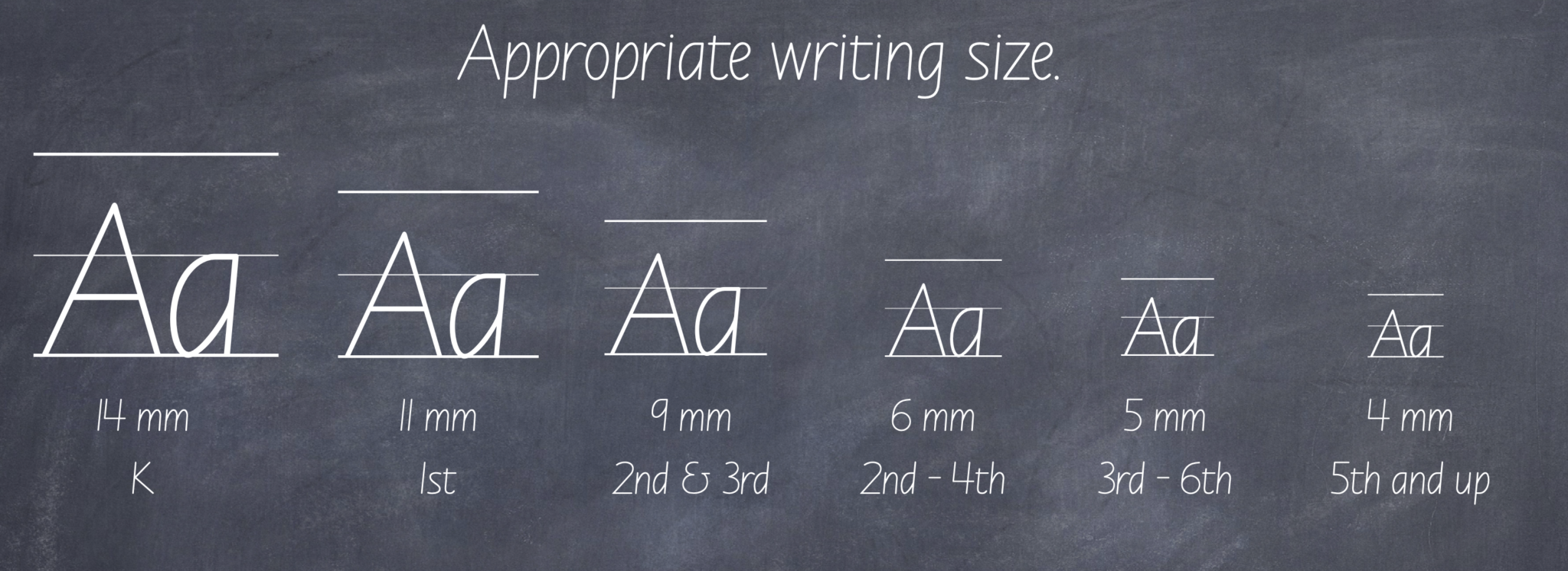
The suggested size of a student's writing changes as they develop. Sometimes that means writing at a size that is larger than what the student prefers. The idea of the larger letters during direct instruction and explicit practice is so that students can actually see and control the letterforms as they write. It is helpful and important, at times, to have students write even bigger, on sand/shaving cream trays, on big sheets of paper on the wall, or in the air. It helps especially with stroke sequence — the “pen path” of the letter.
The authors Getty and Dubay have worked with thousands of students, and consulted with many teachers. These writing sizes in the Getty-Dubay® Italic Handwriting Series are optimized for the developmental skills commonly found at these grade levels.
When the authors worked with doctors, helping them write more legibly, they had the doctors writing 3-foot-high letters in the air. They weren’t happy about it at first, but did what they were asked, and realized in the end it made their handwriting better.
Sometimes a students will state that the letter height in their workbook is not appropriate for them. Students at the age of 10-13 start writing VERY small, for some reason. It could be an effort toward fluency. Giving students ownership over their writing is important, so do offer them opportunities to write at the size they choose.
The writing size in the Getty-Dubay® Italic Handwriting Series Books A-G doesn’t mean that all the student’s writing at that age has to be that size. Yes, you can have the student use lined paper, where the ruled lines are the baseline and the waistline, and then skip at least a line so that the ascenders and descenders don’t collide. You can also use our DIY Worksheet Generator to produce lined paper of any practical size. Read more about using lined paper.
The image above shows our recommendations by grade level, from left to right, starting with Kindergarten. The measurement represents the x-height (body height) of the lowercase letter without an ascender or descender.
Kindergarten — 14mm. Use only the baseline, and separate it from other lines by at least 28mm (twice the lowercase body height).
1st grade — 11mm. You can use Narrow Ruled paper and make the lowercase body height 2 lines tall.
2nd and 3rd grade — 9mm, then 6mm. For ~6mm height, you can use Wide Ruled paper and make the lowercase body height 1 line tall.
2nd (advanced) thought 4th grade — 6mm and 5mm. That's approximately Narrow Ruled paper with the lowercase body height 1 line tall.
3rd (advanced) grade and up — 6mm, 5mm and 4mm. Use either Narrow Ruled paper and make the capital height 1 line tall or use Wide Ruled paper and make the lowercase body height ½ line tall (in this case neither the lowercase letters or capitals will touch the line above).
5th grade and up — 5mm and 4mm. You may use College Ruled paper and leave a gap line between writing lines. The baseline is the focus. Neither the lowercase letters or capitals will touch the line above.