My Story: Why I Fell in Love with History After I Almost Gave Up on It
By Historical Conquest LLC · July 11, 2026
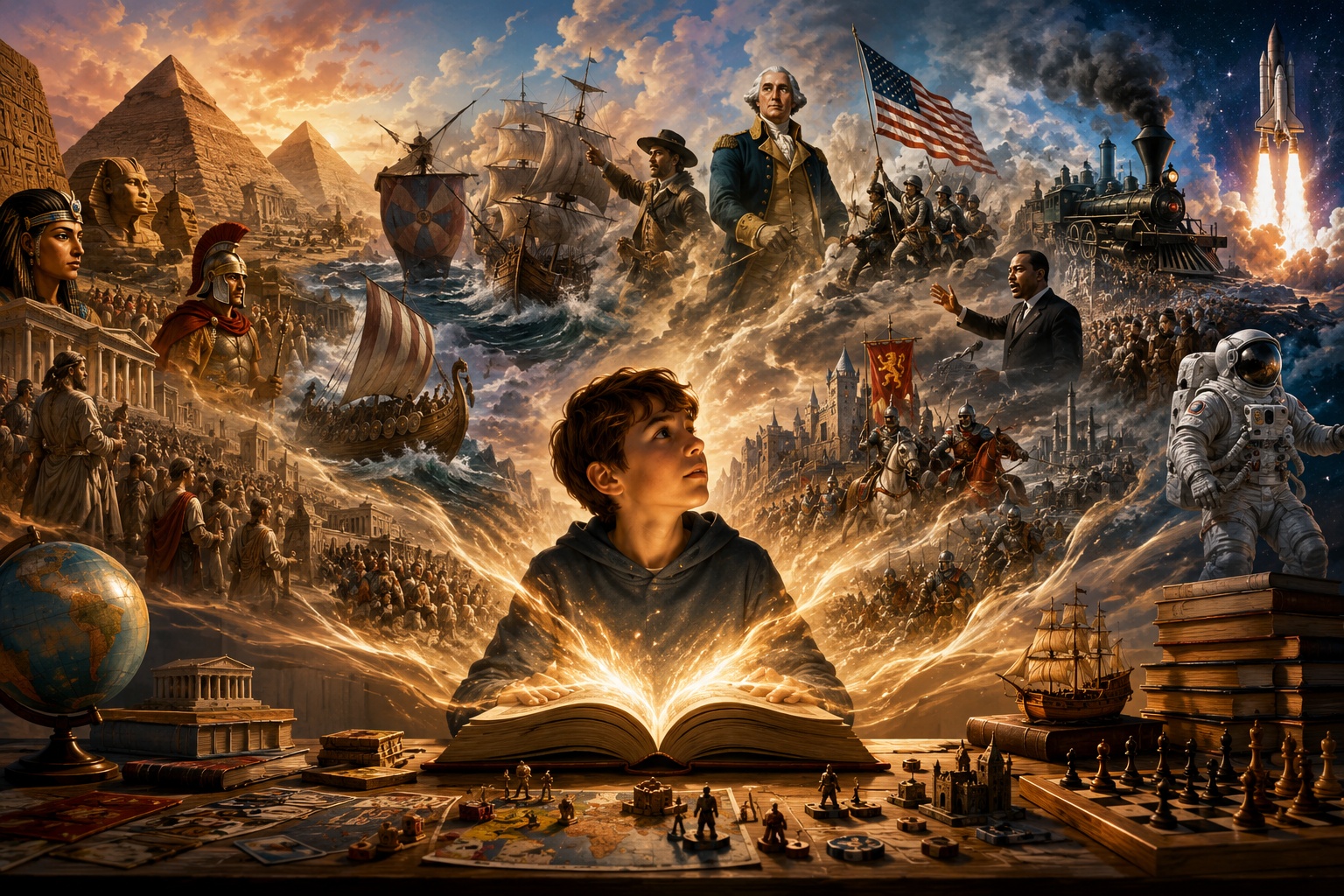
When I was growing up, history was one of the hardest subjects for me to enjoy. It wasn't because I disliked history itself. In fact, I eventually discovered that I absolutely loved it. The problem was how it was taught.
Most of my history classes felt like I was flying thousands of feet above the events we were supposed to be learning. We would quickly jump from one date to another, memorize a few names, pass a test, and then move on to the next chapter. It felt like looking at a map from an airplane. You could see the outlines, but you never experienced the cities, the people, or the adventures happening on the ground.
History became a list of facts instead of a collection of incredible human stories.
As a student, I wanted to know what it actually felt like to stand beside George Washington before a battle. I wanted to understand why explorers risked everything to sail into the unknown. I wanted to hear the conversations leaders had before making decisions that changed the world. I wanted to know what ordinary families experienced during wars, discoveries, inventions, and revolutions.
Those stories were rarely told.
Instead, history often became a race to cover hundreds or even thousands of years before the school year ended.
Years later, I realized something important.
People don't naturally remember facts.
They remember stories.
Long before books existed, civilizations passed their history from one generation to another through storytelling. Around campfires, in homes, through songs, and through traditions, stories carried wisdom, values, and history for thousands of years. Our brains are designed to connect with stories because stories create emotion, and emotion helps create lasting memories.
That realization completely changed how I viewed education.
Instead of asking, "How can students memorize history?" I started asking, "How can students experience history?"
That question eventually became the foundation for Historical Conquest.
Rather than simply memorizing dates, students become explorers, generals, inventors, rulers, scientists, and everyday people living through history. Instead of reading one paragraph about an event, they dive into the personalities, conflicts, victories, failures, and decisions that shaped civilizations. History becomes something they experience rather than something they simply read.
The goal isn't just to help students pass a test.
The goal is to help them remember history for the rest of their lives.
Every Child Learns Differently
One of the biggest lessons I've learned while creating educational games is that no two students learn exactly the same way.
Some children love reading.
Others need to build something with their hands.
Some remember information best after hearing it discussed.
Others need movement, conversation, creativity, or visual examples before the ideas truly click.
When we teach every student exactly the same way, many students begin believing they simply "aren't good at history."
Most of the time, that isn't true.
They simply haven't been taught in the way their brain learns best.
Educational researchers have long recognized that students benefit from learning experiences that engage different strengths and preferences. While people often refer to "learning styles," the strongest evidence suggests that students learn best when they encounter material in multiple ways rather than relying on a single approach. The more senses and experiences involved, the more opportunities the brain has to build durable memories.
Parents have an incredible opportunity to make learning come alive by mixing approaches together.
Consider incorporating activities that engage a variety of ways of learning:
Visual — Maps, timelines, illustrations, documentaries, diagrams, and historical artwork.
Auditory — Audiobooks, discussions, podcasts, storytelling, speeches, and music from the historical period.
Reading and Writing — Journaling, biographies, historical novels, primary sources, essays, and letter writing.
Hands-On (Kinesthetic) — Crafts, building models, cooking historical recipes, experiments, museum visits, and reenactments.
Logical — Strategy games, analyzing cause and effect, solving historical mysteries, comparing civilizations, and examining evidence.
Social (Interpersonal) — Family discussions, debates, group projects, role-playing, and cooperative games.
Independent (Intrapersonal) — Personal reflection, creative writing, independent research, goal setting, and self-paced learning.
The more of these experiences you combine, the more likely your child is to stay engaged and remember what they learn.
Why Games Can Transform Learning
Children naturally learn through play.
Long before children learn to read, they learn by exploring, experimenting, pretending, competing, solving problems, and playing games. Those same instincts never completely disappear.
When learning feels like play, students willingly spend more time practicing important skills.
Educational games can combine many learning approaches at once. A well-designed game may require students to read cards, study artwork, discuss strategies, make logical decisions, remember historical facts, work with teammates, and physically interact with the game—all within a single session.
That combination creates an experience that is often far more memorable than reading a textbook alone.
This is one reason I created Historical Conquest.
Historical Conquest was designed to help students experience history instead of merely memorizing it. As players build civilizations, command armies, negotiate alliances, collect historical figures, and encounter real historical events, they begin making connections that are difficult to achieve through lectures alone.
The game is not intended to replace books, teachers, or traditional lessons. Instead, it complements them by giving students another meaningful way to engage with the material.
A Balanced Approach to Learning
Children today spend more time on screens than any generation before them. Many apps, games, and social media platforms are intentionally designed to capture attention for as long as possible. While technology can be a valuable educational tool, it should not be the only one.
Some of the richest learning experiences happen away from a screen.
Read together.
Visit museums.
Explore historical sites.
Play educational board games.
Build projects.
Go outside.
Have family discussions around the dinner table.
Ask questions.
Imagine what life was like hundreds or even thousands of years ago.
Learning becomes unforgettable when children actively participate instead of simply watching.
My Hope for Every Student
Looking back, I don't wish I had memorized more dates.
I wish someone had invited me into the stories sooner.
History isn't just about kings, presidents, battles, or governments.
It's about people.
People who faced impossible decisions.
People who made courageous sacrifices.
People who failed, learned, persevered, and changed the world.
Those are the stories that inspire young people.
Those are the stories they remember.
And when parents combine storytelling, books, conversations, hands-on activities, outdoor experiences, educational games like Historical Conquest, and opportunities to explore history from many different perspectives, learning becomes something children look forward to instead of something they simply have to finish.
That is the kind of education I wish I had growing up.
It's also the kind of education I hope every child gets to experience.